SUNBA Outdoor PTZ Analog Dome vs SUNBA Outdoor 4K 20X PTZ (2026): Key Differences
As an Amazon Associate we earn from qualifying purchases. Links on this page are affiliate links.
When you compare the sunba outdoor ptz analog camera vs high speed 4k 8mp options, you see two distinct approaches to surveillance. Both units offer 20x optical zoom and IP66 weather resistance for outdoor use. They share similar pan and tilt speeds. The main difference lies in their technology generation. One uses legacy analog signals, while the other delivers modern 4K video over Ethernet. This choice dictates your entire recording setup.
Key differences
| Aspect | SUNBA Outdoor PTZ Analog Dome Camera | SUNBA Outdoor 4K 20X PTZ Camera |
|---|---|---|
| Video Resolution | 960H, 700TVL | 4K (8MP) |
| Connectivity | RS485 Analog | Ethernet (PoE+) |
| Power Source | 18 wire gauge | PoE+ (802.3at) |
| Form Factor | Dome | PTZ Dome |
| Audio | not listed | Two-Way Audio |
Which one should you choose?
Choose SUNBA Outdoor PTZ Analog Dome Camera if
- You are upgrading an existing analog DVR system that uses RS485 controllers.
- You need a camera that integrates with legacy Pelco D protocol equipment.
Choose SUNBA Outdoor 4K 20X PTZ Camera if
- You want high-definition 4K video for detailed remote viewing.
- You prefer simplified wiring using a single Ethernet cable for both power and data.
Verdict: The analog dome suits users maintaining older surveillance infrastructure. The 4K PTZ camera is better for new installations requiring high resolution and modern connectivity. Choose based on your existing recording hardware and desired video clarity.
Resolution and Connectivity Comparison
Video Resolution
The SUNBA Outdoor 4K 20X PTZ Camera delivers 4K Ultra HD resolution, which equates to 8 megapixels. This high pixel count captures fine details from hundreds of feet away, making it ideal for identifying faces or license plates. In contrast, the SUNBA Outdoor PTZ Analog Dome Camera operates at 960H resolution with 700TVL. This analog standard provides lower clarity compared to modern digital sensors. If you need sharp imagery for large areas, the 4K sensor offers a significant advantage. The analog model is limited by its older video standard, which cannot match the crispness of the 8MP digital output.
Connectivity Type
Connectivity differs fundamentally between these two models. The 4K camera uses Ethernet for network connectivity, allowing it to connect to an NVR or computer via standard network cables. This supports digital streaming and remote viewing through smartphones or desktop clients. The analog dome camera relies on an RS485 interface for PTZ control and requires a separate power connection to a 960H analog DVR. You must use specific 18-gauge wire to prevent underpowering issues. If your system is modern and IP-based, the Ethernet connection is essential. The analog interface is strictly for legacy DVR setups.
Power Source
Power delivery methods vary significantly. The 4K PTZ camera supports PoE+, which stands for Power over Ethernet Plus. It requires an 802.3at adapter providing at least 25 watts per port. This allows a single Ethernet cable to carry both data and power, simplifying installation. The analog dome camera does not use PoE. It requires a dedicated power source connected via 18-gauge wire gauge. Using thinner cables can cause voltage drops, especially with 3-in-1 cables. If you want cleaner wiring with fewer cables, the PoE+ option is superior. The analog model needs separate power runs.
Night Vision Range
Both cameras offer similar night vision capabilities. The analog dome camera features IR-Cut True Night Vision with a range up to 100 meters, or 328 feet. It uses an intelligent auto day/night switch. The 4K camera also provides IR-Cut infrared night vision up to 328 feet. It includes an IEC 60825-1 certified laser infrared LED to meet US safety standards. Since both reach the same distance, neither has a clear advantage in range. You can expect comparable low-light performance from either unit. The safety certification on the 4K model is an added detail, but the practical viewing distance remains identical.
Audio Capabilities
Audio support is a key differentiator. The 4K PTZ camera includes a built-in audio interface, allowing for two-way audio communication. You can hear and speak through the camera, which is useful for deterrence or conversation. The analog dome camera data does not list any audio features. It focuses solely on video surveillance via the RS485 port. If you need to interact with people near the camera, the 4K model is the only choice. The analog unit is video-only, limiting its utility for communication purposes.
Remote Viewing Access
Remote access methods differ by system type. The 4K camera supports P2P remote viewing on iOS and Android smartphones. It also offers web access via Internet Explorer and desktop access with a complimentary VMS client for PC and Mac. The analog camera connects to an RS485 port and requires a compatible 960H analog DVR to function. Remote viewing depends entirely on the DVR’s capabilities. You cannot connect the analog camera directly to a smartphone without the intermediate DVR. The 4K camera offers direct, flexible access without extra hardware.
Choose the right PTZ for your setup
Users upgrading to modern digital systems
You need high-definition clarity for identification. This model records in 4K resolution, capturing fine details from long distances. It connects via Ethernet and supports PoE+, allowing a single cable to provide both power and data. This simplifies installation for new digital networks compared to older analog standards.
Existing analog DVR owners on a budget
You are maintaining a legacy system using RS485 interfaces. This analog camera connects directly to 960H compatible DVRs using Pelco D protocol. It requires 18-gauge wiring for stable power. This option avoids the cost and complexity of replacing your entire recording infrastructure with new IP-compatible hardware.
Those needing two-way audio communication
You require interactive surveillance capabilities. This unit includes a built-in audio interface for two-way voice communication. It also supports H.265 compression to reduce storage usage. You can view live feeds remotely via smartphone or desktop clients, offering greater flexibility for monitoring and responding to events in real time.
The products compared

SUNBA Outdoor PTZ Analog Dome Camera
Best for: Legacy analog systems needing high zoom
- Video Resolution
- 960H, 700TVL
- Power Source
- 18 wire gauge
- Connectivity
- RS485
- Placement
- Indoor/Outdoor
- Pan And Tilt
- 0~360° pan, -5~90° tilt
- Night Vision Type
- IR-Cut True Night Vision
View on Amazon: SUNBA Outdoor PTZ Analog Dome Camera Affiliate link
This is a SUNBA outdoor analog PTZ dome camera, not an IP model. It features 22X optical zoom and 700TVL 960H resolution. The unit provides up to 328ft night vision and rotates 360° horizontally. It connects via RS485 and requires 18-gauge wiring. You should choose this if you need a budget analog PTZ for existing DVR systems. It suits users who prioritize zoom range over high-definition clarity.
Pros
- 22X optical zoom lens
- 360° horizontal pan range
- Up to 328ft night vision
- IP66 weatherproof rating
Cons
- 960H resolution is lower than 4K competitors
- Requires specific 18-gauge wiring
- Uses RS485 analog connection only
Good fit if
- You are upgrading an existing analog DVR system
- You need long-range optical zoom for distant targets
- You prefer wired RS485 connectivity over Wi-Fi
Skip if
- You require 4K or ultra-high-definition video
- You want to use standard IP network cables
- You need wireless or app-based control
Verdict: SUNBA 960H Analog PTZ Dome is a solid choice for users maintaining legacy analog infrastructure who need strong zoom capabilities. It delivers reliable pan and tilt coverage for older surveillance setups.
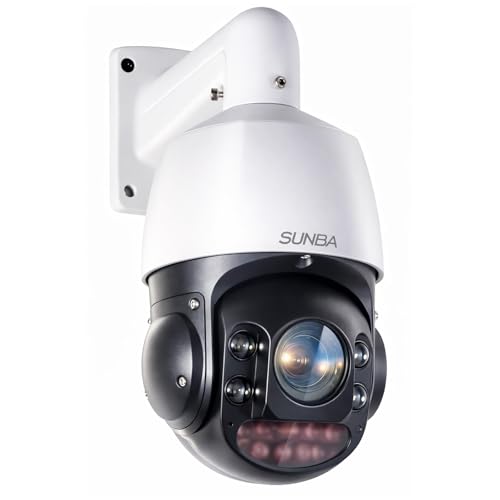
SUNBA Outdoor 4K 20X PTZ Camera
Best for: Long-range outdoor monitoring
- Video Resolution
- 4K (8MP)
- Power Source
- PoE+ (802.3at)
- Connectivity
- Ethernet
- Placement
- Outdoor
- Pan And Tilt
- 360° rotation, -5° to 90° tilt
- Night Vision Type
- IR-Cut infrared LED
View on Amazon: SUNBA Outdoor 4K 20X PTZ Camera Affiliate link
This is a SUNBA outdoor PTZ dome camera with 4K 8MP resolution and 20x optical zoom. It uses PoE+ wiring for single-cable installation. The unit offers 360-degree pan and 90-degree tilt. Night vision reaches 328 feet. You get two-way audio and smartphone alerts. This model suits users needing long-range detail in outdoor settings.
Pros
- 4K 8MP video resolution
- 20x optical zoom lens
- PoE+ power and data
- 328ft infrared night vision
- 360-degree pan and 90-degree tilt
Cons
- Heavier build at 4 pounds
- Requires PoE+ 25W adapter
- Limited upward tilt angle
Good fit if
- You need long-range zoom
- You want 4K clarity
- You prefer PoE wiring
Skip if
- You need battery power
- You require indoor use only
- You want wireless connectivity
Verdict: SUNBA 4K 20X Optical Zoom PTZ delivers high-resolution surveillance with powerful zoom. It fits outdoor sites where you need to see details far away.
Specifications side by side
| Spec | SUNBA Outdoor PTZ Analog Dome Camera | SUNBA Outdoor 4K 20X PTZ Camera |
|---|---|---|
| Video Resolution | 960H, 700TVL | 4K (8MP) |
| Power Source | 18 wire gauge | PoE+ (802.3at) |
| Connectivity | RS485 | Ethernet |
| Placement | Indoor/Outdoor | Outdoor |
| Pan And Tilt | 0~360° pan, -5~90° tilt | 360° rotation, -5° to 90° tilt |
| Night Vision Type | IR-Cut True Night Vision | IR-Cut infrared LED |
| Camera Count | 1 Count (Pack of 1) | 1 Count (Pack of 1) |
| Weather Rating | IP66 | IP66 |
| Form Factor | Dome | PTZ |
| Resolution | not stated | 8MP |
| Features | Night Vision, Optical Zoom | Night Vision, Optical Zoom, Two-Way Audio |
| Color | Black | White |
| Dimensions | 10 × 5.04 × 6.69 inches | 5.35 × 5.35 × 9.02 inches |
| Weight | not stated | 4 pounds |
| Size | 1 Count (Pack of 1) | 1 Count (Pack of 1) |
| Model | UK-405-22X-FBA | 405-D20X 4K |
Frequently asked questions
Does the SUNBA analog dome use digital or optical zoom?
It uses optical zoom. This model provides 20x optical zoom capabilities. Optical zoom magnifies the image using lens elements without losing resolution. This allows you to see distant details clearly. Digital zoom simply crops the image, which reduces clarity. The analog dome retains full image quality while zooming in on specific areas of your property.
Can I connect the 4K PTZ camera to my existing analog DVR?
No, you cannot connect it directly. The 4K model uses PoE connectivity. It requires a network video recorder or a PoE switch. The analog dome connects to legacy analog DVRs via coaxial cable. You must upgrade your recording system to use the 4K camera. Mixing these types on the same standard analog infrastructure is not possible without additional conversion hardware.
What are the physical dimensions of the analog dome camera?
The analog dome measures 5.04 inches wide, 6.69 inches high, and 10 inches long. It comes in a black color option. The form factor is a dome style. These dimensions help you plan mounting locations. The compact size allows it to blend into outdoor structures while providing wide coverage for your surveillance needs.
Does the 4K PTZ support two-way audio?
Yes, it supports two-way audio. This feature allows you to speak and listen through the camera. You can communicate with people near the lens. The analog dome does not list audio capabilities in its specifications. If you need remote communication, the 4K model is the better choice for your outdoor monitoring requirements.
How does the resolution difference affect image quality?
The 4K model offers 8 megapixels of resolution. This captures fine details like faces and license plates from far away. The analog dome uses 960H resolution. This is standard for older systems but lacks the clarity of 4K. You will see sharper images with the 4K camera, especially when zooming in on distant objects.
Is the 4K PTZ camera heavier than the analog dome?
The 4K PTZ weighs 4 pounds. The analog dome does not list a weight in its specifications. The 4K model is white and has a different form factor. Its weight may require sturdy mounting hardware. You should ensure your mounting surface can support the camera's mass for safe and stable operation outdoors.